
Your Work Brain on AI: What Changes When You Start Using It Every Day
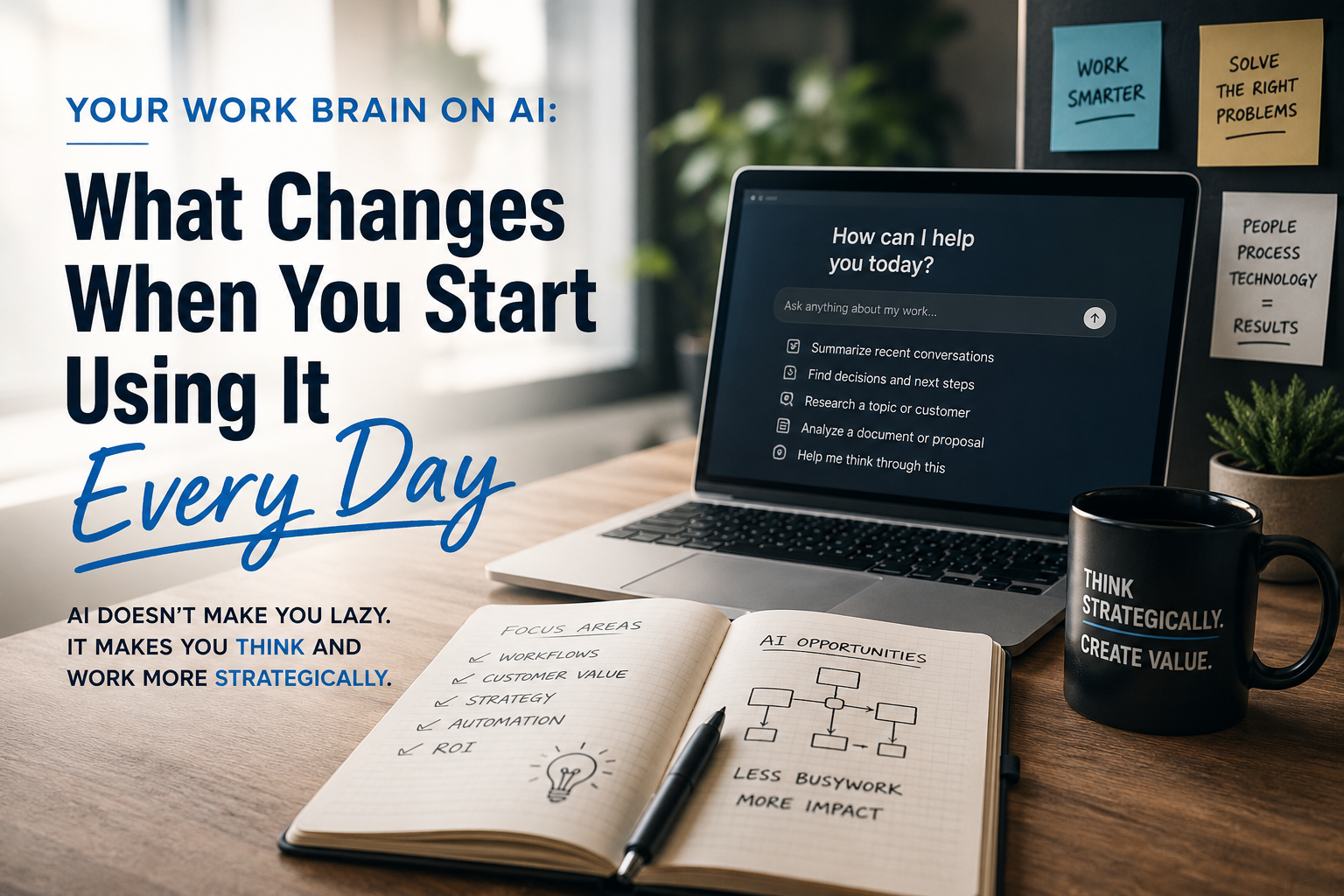
I’ve been thinking a lot lately about how much my own work habits have changed since AI became something I use every single day. I don’t mean using ChatGPT once in a while to clean up an email, summarize a document, or help with a bit of research. I mean using AI as a regular part of how I work.
At some point, something pretty interesting happens. Your work brain starts to change.
The way I look for information has changed. The way I start projects has changed. The way I prepare for meetings has changed. Even the way I think through problems has changed.
And that brings me to something I’ve said for a long time. I don’t believe AI makes people lazy. In fact, I think the opposite can happen. Used properly, AI can make you more curious, more strategic, and much more deliberate about where you spend your time.
I Search for Answers Now, Not Files
For years, the way most of us worked was pretty predictable. You needed something, so you went looking for it.
Maybe you opened Google Drive and tried to remember what the file was called. Then you searched a folder, opened the wrong version, backed out, tried again, and eventually remembered that perhaps the information wasn’t in Drive at all. Maybe somebody emailed it to you six months ago.
Then off to Gmail you went.
That was normal knowledge work.
I’ve noticed that I increasingly work differently now. I often start in ChatGPT instead of opening Drive or searching through email. My first thought is no longer, “Where did I put that?” It is, “What am I trying to find out?”
That distinction is bigger than it sounds.
Instead of trying to locate a specific document, I might want to know what a customer and I agreed to three months ago. I might want to understand how an initiative has evolved over several conversations. I might want to compare what someone told me earlier in a project with where things stand today.
My brain is becoming less interested in where the information lives and more interested in what the information means.
We Spent Decades Learning How Computers Wanted Us to Work
Did you know how much of modern office work is really just people adapting themselves to the limitations of software?
We learned to build folder structures. We learned naming conventions. We learned how to search inboxes. We learned which system contained which piece of information. We learned to copy information from one application to another because those applications could not talk to each other.
For years, humans became the connective tissue between systems.
AI starts to flip that relationship around.
Instead of us constantly organizing information in ways computers can understand, computers are getting much better at understanding what we mean.
That changes the interface to work.
Instead of thinking, “Find the Q2 customer presentation in the account folder,” I can increasingly think, “What were the three biggest concerns this customer raised about adopting AI?”
That is a very different way to work.
AI Has Not Made Me Think Less
One of the criticisms I hear about AI is that it is going to make people intellectually lazy. If AI can write, summarize, research, and analyze, the argument goes, why would people bother thinking anymore?
I understand the concern, but that has not been my experience at all.
If anything, I think more now.
The difference is that I spend less mental energy on low-value activities and more on questions that actually matter. If AI saves me twenty minutes of hunting through files and emails, I can use those twenty minutes to think about the customer, the problem, the workflow, the opportunity, or the decision in front of me.
I find myself asking questions like: Are we solving the right problem? What assumption are we making here? Is there another way to approach this? Where is the actual ROI? What would the customer push back on? What are we missing?
That is not laziness.
That is strategy.
I Rarely Start With a Blank Page Anymore
Another thing that has changed dramatically for me is how I start new work.
Years ago, if I were preparing a presentation, writing an article, building a customer proposal, or creating an AI strategy, I would usually begin with a blank document and start figuring things out from there.
Sometimes the hardest part was simply getting started.
Today, I usually begin with a conversation.
I might throw a half-formed idea into ChatGPT and start working it. I will ask it to challenge the idea, look at it from another angle, tell me what is missing, or help me understand how a customer might react.
Then I respond to what comes back.
That is where a lot of the real thinking happens.
I might say, “No, that isn’t right,” or “That part is good, but we need to go deeper,” or “This sounds too generic for an office equipment dealer,” or “Now we’re getting somewhere.”
AI gives me something to react to, and reacting is a very powerful form of thinking.
I no longer need to move from nothing to a finished answer in one leap. I can work through the idea in stages.
My Brain Sees Workflows Everywhere
This is probably one of the biggest ways AI has changed how I look at businesses.
I can hardly hear someone describe a repetitive process anymore without immediately wondering whether AI could improve it.
Someone says, “We get these requests by email and then somebody enters the information into another system.”
My brain goes, “Wait a second.”
Someone says, “Our salespeople spend two hours preparing for every customer review.”
Same thing.
Someone tells me, “We have several people checking these documents because mistakes are expensive.”
Again, I start thinking about the workflow.
This is one of the reasons I talk so much about AI Workflow Assessments.
I don’t believe the right question is, “How do we put AI into sales?” or “How do we put AI into accounting?”
Those are departments, not workflows.
Sales is made up of dozens of individual workflows. Prospecting, research, meeting preparation, proposal creation, follow-up, CRM updates, forecasting, account planning, and more.
The better question is which of those workflows contains enough friction, repetition, information processing, or wasted time that AI could create measurable value.
Once you start thinking this way, it is difficult to turn it off.
AI Has Made Me Better at Framing Problems
Another unexpected change is that I pay much more attention to how I ask questions.
AI rewards specificity.
If I ask, “How can AI help customer service?” I will probably get a broad answer.
If I ask, “Which customer service workflows involve high-volume repetitive questions, require access to company information, consume meaningful employee time, and do not require complex human judgment?” I am going to get something much more useful.
That forces me to think more clearly about the problem before I ask the question.
What are the constraints? What outcome am I actually looking for? What does success look like? What assumptions am I making?
In a strange way, AI has made me more disciplined about thinking.
Better questions usually lead to better answers, but they also lead to better decisions.
I Use AI as a Thinking Partner
I think one of the least interesting ways to use AI is to treat it like Google with a personality.
Ask a question. Get an answer. Move on.
I get much more value from using it as a thinking partner.
I ask it to challenge ideas. I ask it to argue the other side. I ask it to find holes in my logic. I ask it to look at something from a customer’s perspective. I use it to compare approaches, connect ideas, and sometimes tell me why something I think is brilliant might actually be a terrible idea.
That does not mean I hand over judgment.
Quite the opposite.
The more ideas AI can generate, the more important human judgment becomes.
When the cost of producing ideas goes down, the value of knowing which ideas are worth pursuing goes up.
That is a pretty important shift.
The Bottleneck in Knowledge Work Is Moving
For a long time, the bottleneck in knowledge work was production.
How long does it take to research this? How long does it take to write the report? How long does it take to build the presentation? How long does it take to summarize the meeting or analyze the information?
AI is compressing a lot of that work.
So the bottleneck starts moving.
The harder questions become: What should we do? Which opportunity matters most? Which workflow has the best ROI? Which problem is worth solving? What should we ignore?
Those are not production questions.
They are strategic questions.
And I think that is why the idea that AI automatically makes people lazy misses what is really happening.
When AI removes some of the busywork, we have an opportunity to spend more time on judgment, direction, creativity, and decision-making.
Some Old Ways of Working Are Starting to Feel Ridiculous
There is one funny side effect of all of this.
Once you start working this way, some of the things we have accepted for years begin to feel absurd.
Opening seven folders to find one document feels ridiculous.
Searching through dozens of emails looking for one conversation feels ridiculous.
Copying information manually from one system into another feels ridiculous.
Rebuilding the same report every week feels ridiculous.
For years, we accepted those tasks because technology required humans to do them.
That does not mean those tasks were valuable.
It just meant they were necessary.
AI is starting to remove some of that necessity.
And once people experience a better way of working, I don’t think they will be very interested in going backwards.
So, Does AI Make Us Lazy?
Can somebody use AI lazily? Of course.
You can use Google lazily. You can use Excel lazily. You can use a calculator lazily.
That is not really the question.
The better question is what happens when someone learns to use AI well.
For me, I spend less time searching for information, less time fighting blank pages, and less time doing repetitive work.
But I spend more time questioning things.
I spend more time exploring ideas. More time thinking about customers. More time spotting workflows. More time challenging assumptions. More time deciding what matters.
My workday is slowly moving away from searching and producing and toward reasoning and deciding.
And I think that is where knowledge work is heading.
At first, AI helps you write an email. Then it helps you summarize a document. Then it helps you prepare for a meeting. Then you start using it to search across your work. Then you start asking it to challenge your thinking.
Eventually, you realize something has changed.
You are not simply using a new piece of software anymore.
The way you work has changed.
And maybe more importantly, the way you think about work has changed too.
That, to me, is where AI gets really interesting.
Last updated: August 17, 2026