
AI Isn’t Broken. Your Systems Might Be.
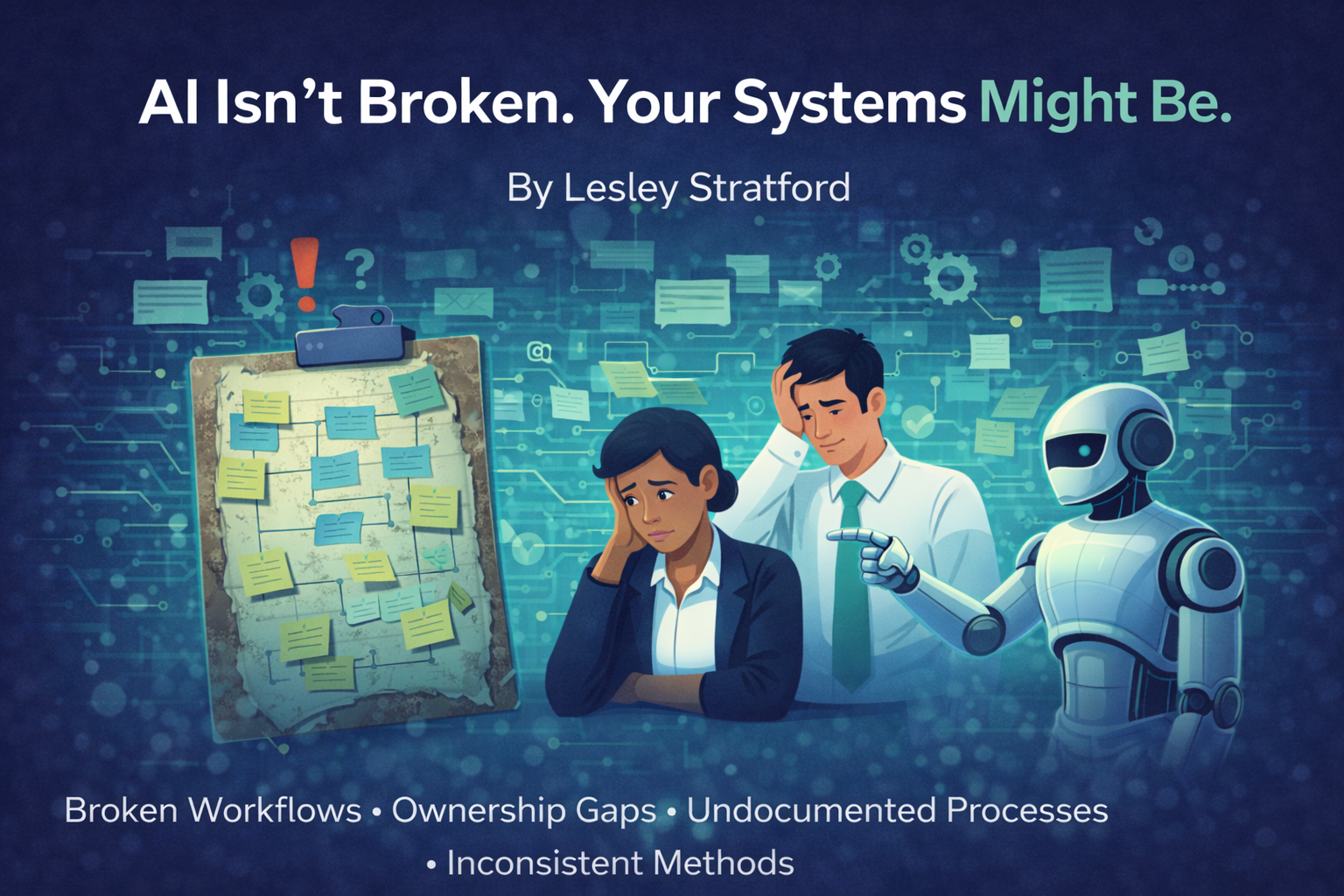
AI is often introduced as the solution to chaos.
Teams are overwhelmed. Systems feel clunky. Work takes longer than it should. So when a new AI tool promises speed, efficiency, and clarity, it’s tempting to believe this is the thing that will finally make everything easier.
But here’s the hard truth:
AI doesn’t fix broken processes. It exposes them.
That exposure can feel uncomfortable, especially for teams that have been holding things together through sheer effort and hard-earned experience.
AI speeds things up. It doesn’t fix what’s broken.AI doesn’t create structure where none exists. It amplifies whatever is already there.
When processes are clear, documented, and owned, AI can be transformative. It reduces friction, eliminates repetitive work and frees people up to focus on what actually matters. But when processes are unclear, inconsistent, or undocumented, AI doesn’t smooth the edges. It magnifies the cracks.
Humans are incredibly good at compensating for broken systems. We remember things that aren’t written down. We fill in gaps with context. We adjust on the fly when a process doesn’t quite work and over time, these workarounds become invisible.
Most AI doesn’t have that ability. Unless you're diving into truly Agentic, self-determinate AI, which is the topic of a whole other blog.
So for “GenAI”, it follows instructions exactly as they’re given or not given at all. So, it quickly reveals what’s missing, what’s assumed and what was never clearly defined in the first place.
What Broken Processes Actually Look Like
Most organizations don’t think they have “broken processes.” What they have are processes that evolved organically, grew complicated over time and were never intentionally revisited.
Do these sound familiar:
-
Workflows that live in people’s heads instead of being documented
-
Multiple tools doing overlapping jobs
-
No clear ownership over decisions or outcomes
-
Inconsistent ways of doing the same task across teams
-
A heavy reliance on “this is how we’ve always done it”
-
Teams constantly reacting instead of operating with intention
None of this means a team is failing. In fact, it often means the opposite. It means people are working hard to keep things moving, even when the system itself isn’t supporting them.
The Friction Point of AI Adoption
When AI enters the picture, those invisible workarounds stop working.
Suddenly, decisions that were previously avoided need to be made. Ownership must be clarified. Processes that were “good enough” now need definition. Inconsistencies become obvious. Assumptions get challenged.
This is often the point where teams start to feel frustrated and say things like “AI just isn’t working for us” or “This tool isn’t as smart as we expected.” Have you heard these comments or said them yourself?
AI is reflecting the organization back to itself, clearly and without judgment. It’s showing where clarity is missing, where expectations aren’t aligned and where leadership decisions were deferred rather than made.
That discomfort isn’t failure. What is really happening is simply feedback.
It’s information.
Why Exposure Is Actually a Good Thing
It’s easy to see this moment as proof that AI adoption was a mistake. Truthfully, it’s often the most valuable part of the process.
Exposure creates clarity.
Clarity creates choice.
Choice creates the opportunity to design systems intentionally instead of relying on people to compensate using workarounds.
When AI highlights gaps, it gives organizations a chance to slow down and ask better questions:
-
Who actually owns this process?
-
What does “done” really mean here?
-
Why do we do it this way?
-
What’s necessary and what’s just habit?
This is where clarity in how work gets done begins, not with the tool, but with the thinking around it.
What Needs Attention Before (or Alongside) AI
Successful AI adoption rarely starts with technology. It starts with fundamentals.
That doesn’t mean complex frameworks or perfect documentation. It means focusing on a few core areas:
-
Clear ownership: Someone is responsible for decisions, processes and outcomes
-
Simple, documented workflows: Not exhaustive manuals just clarity everyone can reference
-
Fewer tools, used intentionally: Complexity slows teams down more than a lack of features
-
Aligned expectations: Everyone agrees on what success looks like
-
Space to question: AI works best when teams are encouraged to ask “why” before “how”
When these pieces are in place, AI stops feeling like an experiment and starts feeling like support.
AI as a Mirror, Not a Miracle
AI doesn’t replace thinking. It requires better thinking.
It doesn’t eliminate the need for leadership, clarity or structure. It makes their absence impossible to ignore.
If AI is exposing cracks in your organization, that’s not a reason to pull back. It’s an invitation to pay attention. To fix what’s been quietly slowing things down. To build systems that support people instead of relying on them to compensate.
When processes are clear and intentional, AI becomes a real advantage.
When they aren’t, it becomes a stress test.
The difference isn’t the technology.
It’s the work we’re willing to do around it.
Last updated: February 16, 2026